

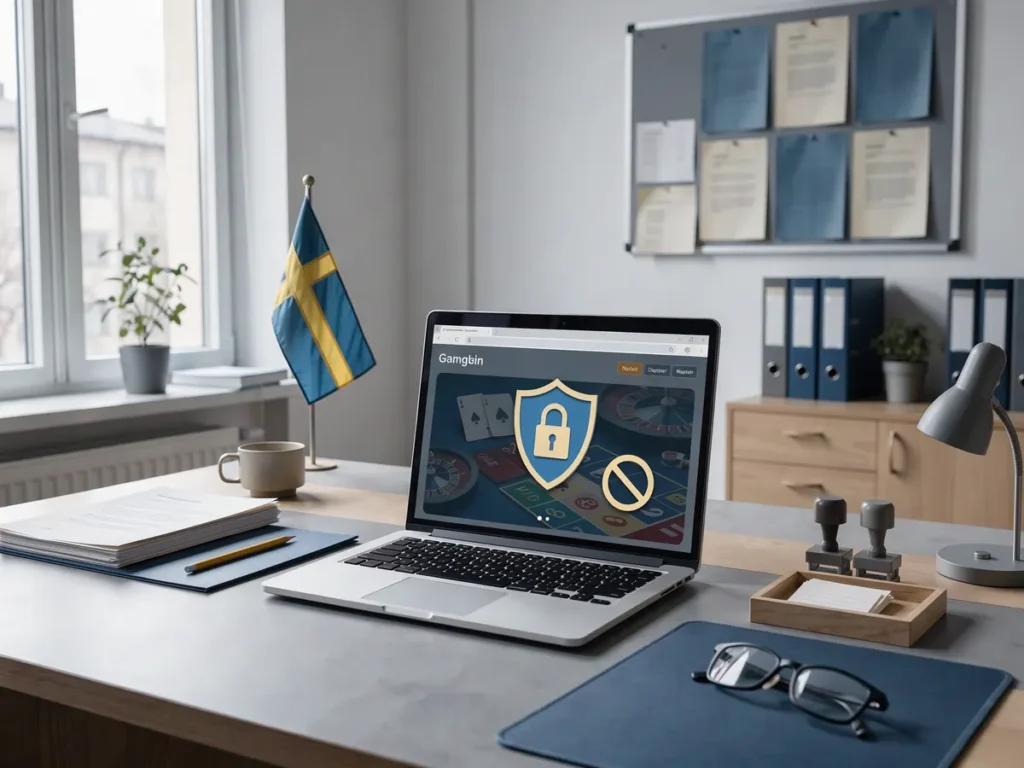
A site that looks Swedish and isn’t
You search for a slot you played last month. The third result loads in Swedish, takes your card, offers a 200% bonus with free spins on top, and never asks you to pass a single check. It is not licensed in Sweden. Nothing on the page tells you that, and no Swedish authority is going to fine it.
That gap is the whole argument behind the current push for gambling enforcement reform in Sweden. The trade body representing the country’s licensed online operators has called for an overhaul of how enforcement works, and the complaint underneath it is structural rather than petty: the regulator’s sharpest tools point at the companies that applied for a licence, while the sites that never bothered carry on largely untouched.
If you only read the headline, this sounds like an industry asking for an easier ride. Read the mechanics and it gets more interesting, because the disagreement is not really about how harsh enforcement should be. It is about where it lands, and about a number that both sides quote with far more confidence than anyone has earned.
Where Swedish gambling regulation actually stands
Sweden’s licensed online market opened on 1 January 2019, replacing a monopoly with a licensing system supervised by Spelinspektionen, the Swedish Gambling Authority. The stated ambition at the time was that at least 90% of all gambling by Swedish players would take place with licensed operators.
The rules that came with the licence are strict by European standards. A licensee may offer a customer a bonus only once, at the start of the relationship, which rules out the rolling reload offers you see almost everywhere else. Every licensee must connect to Spelpaus, the national self-exclusion register, so a single registration locks a player out of every licensed site at once. Since mid-2023 the game software suppliers behind those sites have needed Swedish licences too, which extended the regulator’s reach up the supply chain. And in July 2024 the tax on gross gaming revenue rose from 18% to 22%.
Stack those together and you get the industry’s case in one line: the cost and constraint of being licensed went up, the consequence of being unlicensed did not.
The channelisation number nobody can prove
Here is the honest answer on how much Swedish play has drifted offshore: nobody knows, and every figure you have seen quoted is a model, not a measurement. The trade body’s estimates have consistently run lower than the regulator’s, and both are built on assumptions that cannot be independently checked.
This matters more than it sounds, because channelisation is the metric the entire policy argument rests on. If 9 in 10 kronor stay inside the licensed system, the current settlement is working and the industry is lobbying. If the real figure is meaningfully lower, Sweden has a consumer protection problem dressed up as a compliance success.
The trouble is that measuring unlicensed play means measuring something designed not to be measured. Survey work asks people to self-report gambling with sites they may not know are unlicensed. Traffic estimates infer spend from visits. Payment data captures what passes through identifiable channels and misses what doesn’t. Operator-reported figures only cover operators who report. Each method has a defensible logic and a different blind spot, and the published percentages diverge by enough that the choice of method decides the conclusion.
So I am not going to give you a percentage. Anyone who hands you one to two decimal places is telling you about their methodology, not about the market. What can be said with confidence is narrower and still useful: unlicensed sites serving Swedish players exist in volume, they are reachable in a couple of clicks, and they are not bound by Spelpaus.
Why regulatory enforcement lands on licence holders
A regulator can only sanction what it can touch, and what it can touch is a company that holds a licence, a bank account and an address inside its jurisdiction. That asymmetry is not a Swedish failing; it is the default condition of every regulated online gambling market, and it produces a predictable pattern. Licensees get audited, warned, fined and occasionally stripped of permission. Offshore sites get letters.
The practical reach of the main enforcement tools looks roughly like this:
| Measure | What it bites | Where it stops |
|---|---|---|
| Licence conditions and fines | Operators licensed in Sweden | No effect on sites without a licence |
| Supplier licensing | Game studios and platforms serving the Swedish market | Suppliers willing to work only offshore |
| Marketing and affiliate rules | Advertising inside the licensed system | Promotion routed through channels outside Swedish reach |
| Site blocking | Access to named domains | Mirror domains, VPNs; not the backbone of Swedish enforcement |
| Payment blocking | Money flowing to identified recipients | Intermediaries, crypto, misdescribed transactions |
Sweden has examined blocking and payment measures through official inquiries without them becoming the core of its approach, while several European neighbours lean on them heavily. Denmark and Italy have long maintained blacklists and DNS blocking of unlicensed domains, and Germany’s regulator has pursued ISP blocking through contested litigation. None of those regimes claims to have eliminated the unlicensed market. They have made it less convenient, which is a real result and a smaller one than the rhetoric around an illegal gambling crackdown usually implies.
The part of the industry’s case I would not accept at face value
The causal story, that the one-bonus rule and the 22% tax pushed players offshore, is plausible and under-evidenced. Both changes sit in the right direction for the argument. Neither has been isolated from everything else that moved at the same time, including the growth of the offshore sector in markets that made no such changes at all.
Operators have an obvious interest in the conclusion that restraints on them, rather than weak policing of everyone else, are driving the leakage. Regulators have an equally obvious interest in the conclusion that channelisation is fine. Treat both as positions with evidence attached rather than findings. The one claim that survives scrutiny from either side is the simple one about reach: a rule that only applies to licensed sites protects only the players on licensed sites.
What stops protecting you the moment you leave the licensed market
Everything Sweden built after 2019 is enforced through the licence, which means it travels exactly as far as the licence does. On an unlicensed site, in practice:
- Spelpaus does not apply, so a self-exclusion you registered in a serious moment does not hold
- No Swedish authority handles your complaint, and Spelinspektionen has no leverage over a withheld withdrawal
- Game RTP and RNG certification rests on whoever the operator chose, verified by nobody you can appeal to
- Deposit limits, loss limits and mandatory reality checks are whatever the site feels like offering
- Tax treatment changes: winnings from a Swedish or EEA-licensed operator are generally tax free for the player, while winnings from operators outside the EEA are treated as taxable income
That last point catches people out, because a bonus that looks 200% better than anything a licensed site can legally offer can be worth less after tax and after a wagering requirement you have no route to dispute. Read the wagering terms before the bonus, always, and read whose rules govern them.
What this tells you about every regulated market
Sweden is not an outlier, it is an early case with good records. The same argument is running in the UK, the Netherlands and Germany, with the same two camps and the same missing number, and it will run wherever a market tightens its licensed sector faster than it can reach the sites outside it.
Whether an enforcement overhaul is the answer depends on an empirical question the current data cannot settle: how much play actually sits offshore, and how much of it is price-sensitive rather than rule-sensitive. Until someone measures that in a way both camps accept, Sweden will keep arguing about percentages that are really arguments about policy. As a player, the practical conclusion arrives much sooner. Check the licence before the bonus, and if you have used Spelpaus, understand that it only works where Swedish law reaches. If gambling has stopped being entertainment for you, the national support services exist for exactly that, and no offshore site is going to point you to them.