

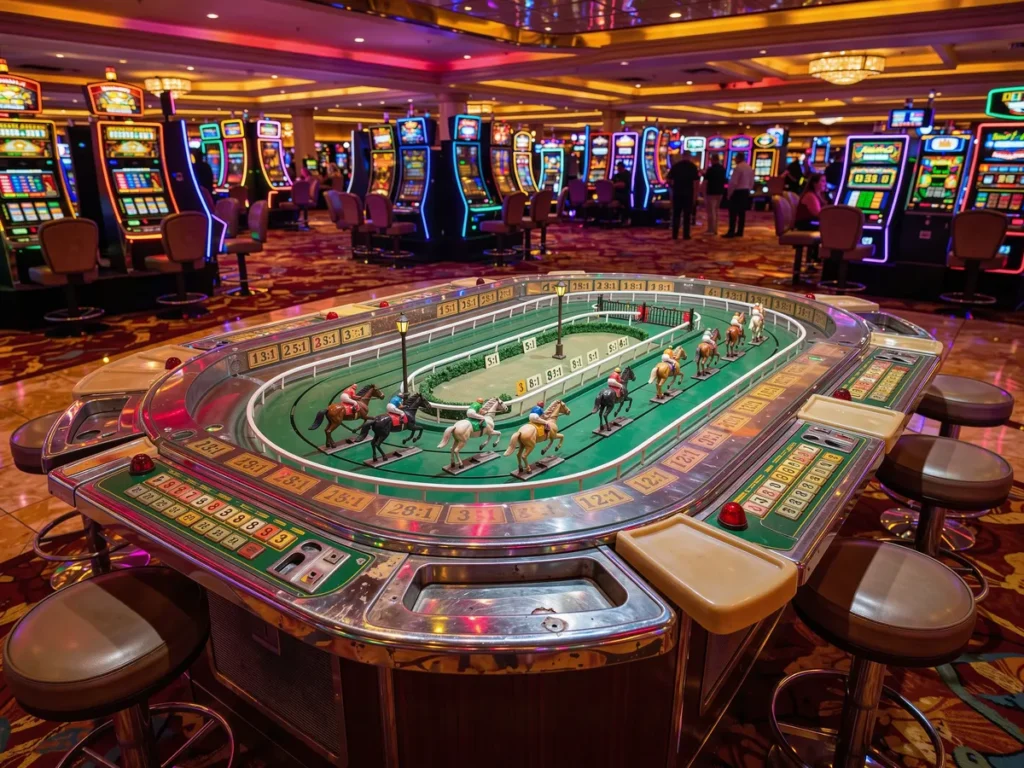
Down to one machine, and that was the whole problem
For years, the number of Sigma Derby machines in public use anywhere has been exactly one. That is about to change: a newly manufactured Sigma Derby is headed for Four Queens on Fremont Street, scheduled to debut next year according to a Las Vegas Advisor report picked up by Casino.org. It would be the first new machine of its kind put into service in decades.
The timing is not an accident. The game’s following grew as its supply collapsed, and downtown Las Vegas has spent the past several years leaning on physical, mechanical, slightly odd attractions as a counterweight to floors of near-identical video slots. A reproduction cabinet is the logical end point of that strategy.
What Sigma Derby is
Sigma Derby is an electro-mechanical horse-racing betting game built around a miniature racetrack, with 10 betting stations arranged around it. It was introduced in 1985 by Japan’s Sigma Game Inc. Players wager small amounts on which horses will finish first and second, little metal horses then advance around the track in uneven bursts, and winners are paid at posted odds.
How the game is played
You take one of the 10 stations, each with its own buttons and a board showing the payout for every horse combination. The classic wager is on which two horses cross the line first and second. Then the race runs, and this is the part no video screen reproduces: the horses jerk forward in fits and starts, one stalling while another runs away with it, and ten strangers start shouting at a tin pony.
Casino.org describes the wagering as pari-mutuel style, meaning the payouts work like a racetrack pool rather than like a slot paytable. The new cabinet accepts stakes from 25 cents to $5. What has always set Sigma Derby apart from the bank of slots next to it is that it is communal and cheap, and a round takes long enough to actually watch.
How a 1985 cabinet turned into a downtown cult object
The game was a staple across Las Vegas casinos into the late 1990s, and it earned its following by offering a social experience that traditional slot machines rarely do. Then the machines started vanishing, and the few survivors took on a strange second life.
The one still in public use has an unusually well-documented history. It originally operated at the New Frontier, was pulled off the floor and put into storage, and was tracked down by Derek Stevens’ team after he acquired Fitzgeralds in 2011. They restored it and made it the centerpiece of the vintage-themed second floor when the property reopened as The D in 2012.
“When we bought Fitzgerald’s, we wanted to give the second floor a vintage feel,” Stevens told Casino.org in 2022. “I always had a special place in my heart for Sigma Derby, and it was perfect for the vibe we were going for.”
This summer he moved it again, from The D to the Golden Gate, which he also owns. The relocation came with a parade on June 16, 2026, escorting the machine west along Fremont Street. A casino throwing a procession for a single gambling device tells you most of what you need to know about the game’s status downtown.
What actually killed it was maintenance, not demand
Sigma Derby disappeared because the machines became impossible to keep running. Replacement parts grew scarce and the aging mechanisms demanded constant attention, per Casino.org’s reporting. A video cabinet that breaks gets a new board. A 40-year-old electro-mechanical racetrack that breaks needs a part that nobody manufactures and a technician who has seen one before.
That distinction matters for anyone reading this as a nostalgia story. The game did not lose a popularity contest to digital slots. It lost a logistics argument. Which is also why a brand new build is a bigger deal than another restoration: restorations run out of donor machines.
What Four Queens is installing
The revamped Sigma Derby was unveiled at this year’s Global Gaming Expo in Las Vegas, where, according to industry reports, the reproduction was faithful enough that some observers assumed they were looking at a restored vintage unit. Three companies are behind it: Next Gaming, Highbrow Gaming and VSR Industries.
Four Queens being first in line is not a coincidence either. Property owner Terry Caudill founded and owns Next Gaming.
The exterior is largely unchanged. The internals are not. Per the announcement, the new machine adds ticket-in/ticket-out, bill acceptance and a digital display tracking previous winning horses, with wagers from 25 cents to $5. Operators can also configure the theoretical return-to-player percentage.
That last detail is where the public evidence stops, and I am not going to fill the gap with a plausible number. The reported configurable range has not been published in full, and nothing has been announced about where Four Queens intends to set its own machine. Until the property says so, nobody outside the manufacturers can tell you what this cabinet returns. What can be said with certainty is the direction: a configurable RTP is configured below 100%, so the house edge stays intact however charming the horses are.
One more thing about that digital board of previous winners. It is a nice touch and a useful piece of theatre, but previous results carry no information about the next race. Each outcome is independent, on a mechanical game exactly as on an RNG slot.
Why downtown keeps reaching for retro
Differentiation is the straightforward reason. If every floor in the city runs the same licensed slot themes from the same handful of suppliers, the only thing left to compete on is the machine nobody else has. Downtown has built an identity around being the older, scruffier, more authentic alternative to the Strip, and physical games fit that story in a way a new video cabinet never will. Circus Circus expanding its coin-operated slot offering points the same way.
There is a second, less sentimental reason: attention. A communal game with ten seats and a visible mechanism generates noise, crowds and photographs. Older players get the nostalgia; younger visitors get something worth filming. A standard slot bank gets neither.
The honest caveat is that none of this changes the arithmetic. Retro styling is presentation, not odds, and a quarter-stakes race is still a negative expectation bet over time. Treat it as cheap entertainment with a set budget, use deposit and loss limits where they are available, and stop when the fun does.
Where to find it, and what’s still unsettled
The new Sigma Derby is slated for Four Queens, on Fremont Street in downtown Las Vegas, next year per the Las Vegas Advisor report. The last original in public use sits a short walk west at the Golden Gate, which means that for a while downtown will be the only place on earth to play either version.
What nobody can answer yet is whether a manufactured Sigma Derby holds the same pull as a scarce one. Part of the appeal of the Golden Gate machine is that there is precisely one of it. If the reproduction sells in volume and turns up on a dozen floors, the cult loses its scarcity and keeps only the game. That may be enough. The number that will decide it, the return operators actually dial in, has not been published.