

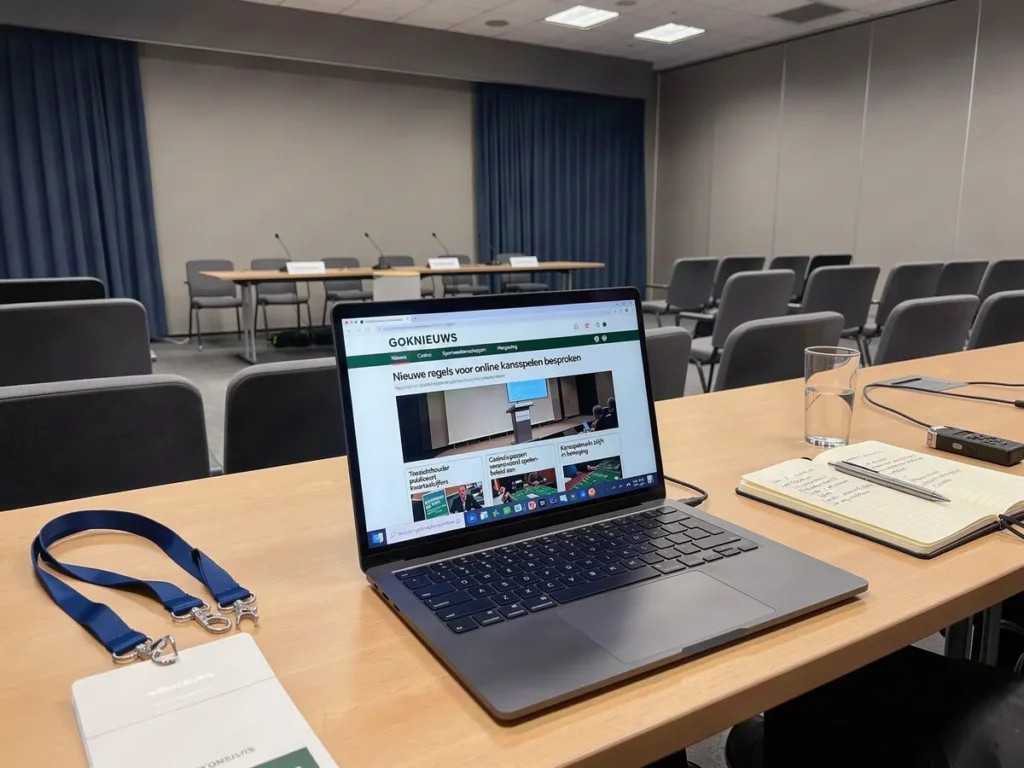
The announcement, and the number sitting behind it
SBC Summit Europe has named CasinoNieuws.nl as a media partner, confirmed this week ahead of the event. On its own, the SBC Summit Dutch gambling partnership is a modest piece of business: a Dutch-language news outlet agrees to cover and promote a conference, the conference gets reach into a specific national audience. What makes it worth a paragraph is where that audience sits right now. Licensed operators in the Netherlands pay gambling tax at 37.8% of gross gaming revenue in 2026, up from 34.2% in 2025 and 30.5% before that.
That is the context a press release doesn’t carry. A market with a tax line approaching two fifths of revenue, a near-total advertising clampdown and mandatory deposit limits is not a market that needs more trade-show footfall for its own sake. It is a market where operators, affiliates and suppliers are actively looking for places to compare notes on surviving the squeeze.
What the partnership actually covers
A media partnership of this kind is a distribution arrangement, not an editorial merger and not a commercial endorsement of anyone’s product. The conference organiser gains a channel into Dutch-language readers; the publisher gains access, accreditation and content from an event its readers care about. Money, where it moves at all in these deals, usually moves as promotional inventory rather than as payment for favourable coverage.
CasinoNieuws.nl is a Dutch-language news site covering the regulated gambling market: licence decisions, enforcement actions from the Kansspelautoriteit, political debate in The Hague, operator results. It writes for people who follow the industry, not for people choosing where to play tonight. That distinction matters more than anything else in this story, and it is the part most readers skip.
The misreading that costs players money
A “media partner” badge says nothing about whether a casino is safe, licensed or worth your deposit. It describes a relationship between an events company and a publisher. Yet the vocabulary of industry announcements leaks constantly into consumer-facing marketing, where “official partner”, “award-winning” and “as featured at” get bolted onto landing pages until they look like a regulator’s stamp.
The cost of confusing the two is concrete. A player who treats trade-press visibility as a safety signal can end up depositing with an operator that holds no Dutch licence at all, which means no Cruks self-exclusion check, no deposit-limit obligation, and no route to the Kansspelautoriteit if something goes wrong. The only check that answers the question is the licence register itself, published by the Kansspelautoriteit. Conference partnerships, panel appearances and industry awards are all downstream of that, and none of them substitutes for it.
The same applies in reverse for operators reading the news. Appearing on a European summit agenda does not soften a single Dutch rule.
Why the Netherlands market is worth a European summit’s attention
The Dutch online market is young, fully licensed and tightening faster than almost any other in Western Europe. Legal online gambling only began in October 2021 under the Remote Gambling Act, which makes it roughly five years old as a commercial market. Almost every year since has added a restriction.
| When | Change | Effect on operators |
|---|---|---|
| October 2021 | Licensed online market opens under the Remote Gambling Act | First legal online casino and sportsbook licences issued |
| July 2023 | Ban on untargeted gambling advertising | TV, radio, print and public outdoor advertising closed off |
| 2024 | Sponsorship restrictions begin to phase in with a ban on sponsoring programmes and events | Programme and event deals wound down |
| October 2024 | Mandatory deposit-limit framework and stricter duty-of-care checks | Default limits, intervention duties, extra scrutiny for young adults |
| 2025 | Shirt sponsorship ban takes effect | Sports and team kit deals wound down |
| 2025 | Gambling tax rises to 34.2% of GGR | Margin compression across the licensed sector |
| 2026 | Gambling tax rises again to 37.8% of GGR | Marketing and bonus budgets squeezed further |
Put those together and you get the agenda items that European conferences keep returning to: how to acquire players without advertising, how to apply affordability checks without pushing people offshore, and how a business model built on 2021 assumptions survives a 2026 tax rate. The Netherlands is not a large market by population. It is a useful one to watch, because it is running the experiment that several other European regulators are still debating.
What changes in practice, and what doesn’t
For the Dutch iGaming industry, the practical effect is more Dutch-language reporting from a conference floor where Dutch-language reporting has been thin. That is genuinely useful if you work in compliance, affiliate marketing or product at a licensed operator: you get sessions, speaker lists and panel arguments summarised in your own language, without waiting for them to filter through English-language trade press.
For a player in Amsterdam deciding between two licensed sites, nothing changes. No RTP moves, no bonus term improves, no withdrawal clears faster because a conference signed a media partner. The honest answer is that this is B2B news, and B2B news earns its place on a consumer site only when it explains why the products are changing, which in the Dutch case it does. Advertising bans and a 37.8% tax rate are exactly why Dutch welcome offers have become smaller and wagering requirements less generous than they were in 2022. The regulatory pressure shows up in the terms and conditions, not in the press release.
The question this doesn’t settle
What no partnership announcement can tell you is whether the Dutch approach is working. Every restriction added since 2021 was designed to reduce harm in the licensed market, and every one also widened the gap between what a licensed site can offer and what an unlicensed one can. Whether Dutch players have stayed inside the regulated perimeter or drifted out of it is the live argument, and it is the argument that actually determines whether the next round of rules tightens again or eases.
Conferences are where that argument gets had out loud, which is the reason a Dutch outlet in the room is worth more than the deal size suggests. If you play, the practical takeaway is narrower and older than any of it: check the licence register before you deposit, set a deposit limit while you are still calm enough to pick a sensible number, and remember that Cruks exists and takes about a minute to use. Every game on every licensed Dutch site carries a house edge, and no amount of industry news changes that arithmetic.