

The part of gaming technology nobody demos on a trade show floor
Innovation in casino technology is usually taken to mean something a player can see: a new mechanic, a taller cabinet, another screen. The Renova Technology logistics platform announced on Wednesday, 28 October 2026 is none of those things. Renova 360 pulls reverse logistics, forward logistics and product lifecycle support into one vendor relationship, and it arrived in the company’s 30th year of business. Nobody is going to queue up to look at a spare parts shelf, which is roughly the point.
Renova was founded in 1996 to solve a narrow problem for a point-of-sale and ATM manufacturer: it needed a repair partner that could also capture repair data. Three decades later the customer list reads as commercial equipment with long product lifecycles, gaming and lottery systems among them, alongside public safety and security technology. Those are the markets where a dead unit in the field costs money or creates risk every hour it stays dead.
What Renova 360 actually bundles
Renova 360 is four service packages sold as one programme, configured per customer. The company frames it as closing the loop on returns and return merchandise authorisation: when a unit fails in the field, a replacement ships from stock the same day while the de-installed unit is diagnosed, repaired and put back on the shelf, all inside the same facility.
| Package | Scope |
|---|---|
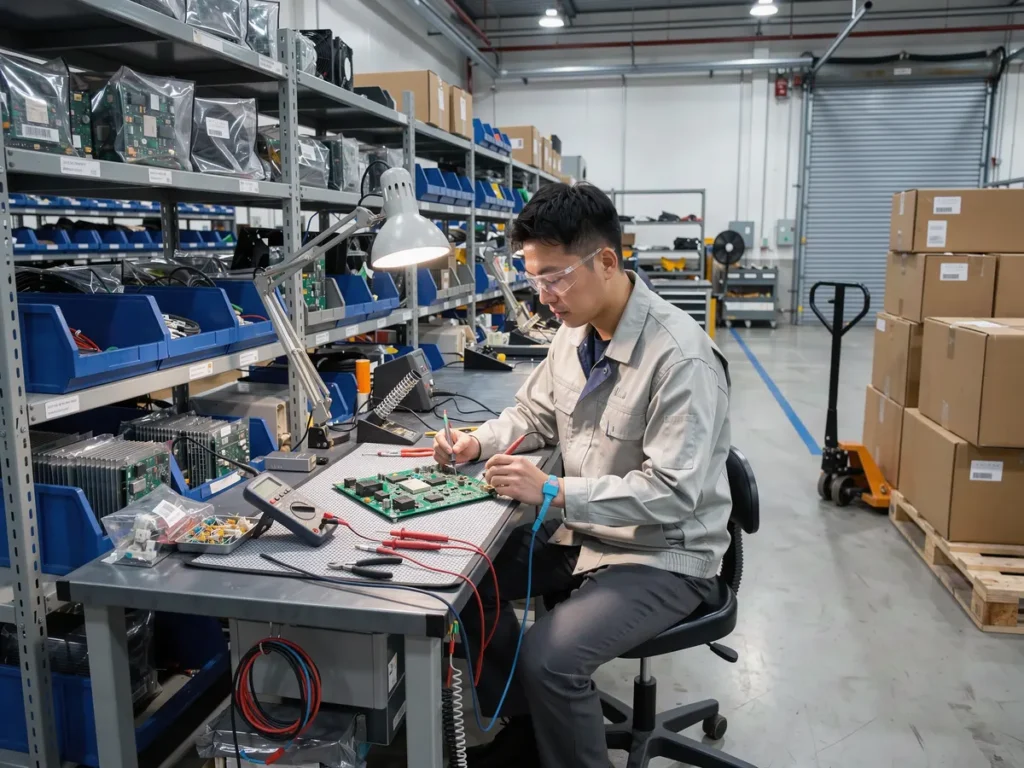
| Renova Repair | Depot repair and diagnostics, component-level PCB and PCBA repair, rework and ball grid array work, functional testing, failure analysis, repair data reporting |
| Renova Reverse | Returns inspection, RMA and warranty management, advanced exchange, spare parts and replacement inventory, equipment tracking |
| Renova Forward Logistics | Configure-to-order, kitting and light assembly, testing and quality control, order fulfilment, support for large-scale rollouts |
| Renova Product Lifecycle Support | Inventory management including small parts and spares, refurbishment, end-of-life support, asset disposition and component recovery, storage |
Alongside the launch, Renova says it has expanded its inventory management programmes to better support configure-to-order, small parts management and same-day advanced exchange, which it describes as the current expectation rather than a differentiator. Chief marketing officer Louis Pine put the commercial logic plainly in the announcement: “As manufacturers tighten their supply chains, they want partners closer to home with value-added capabilities.” He called the ability to pull a replacement off the shelf in the same facility that handles the RMA a game changer.
The target buyers are OEMs and contract manufacturers, field service organisations, integrators and dealers, and enterprise technology teams. Note what that list does not say: this is not a casino product. Gaming and lottery is one named vertical in a wider pitch.
Three ways to get a failed cabinet back into service
A manufacturer or route operator with units in the field has three realistic arrangements, and Renova 360 is a bet on the third.
The first is the split-vendor model: one depot repairs boards, a separate third-party logistics provider warehouses and ships, and the spares pool sits somewhere between them. It is easy to price, easy to benchmark, and easy to exit, because every piece has substitutes. Its weakness is the handoff. Every unit that has to travel between two vendors adds days, and every day a replacement spends in transit is a day it is not on a shelf.
The second is keeping repair in-house. It gives the best visibility and the tightest feedback into engineering, and it is the most expensive way to maintain component-level board repair capability for products that fail rarely. Rework and BGA work need equipment and technicians who stay sharp, which means volume. Most suppliers do not have that volume on legacy platforms.
The third is the single-vendor closed loop that Renova is now selling under one name. The structural argument is sound and does not need a statistic to follow: if the facility holding the replacement stock is the same facility that receives, diagnoses and repairs the return, the transit leg between vendors disappears and the spares float shrinks, because units spend less time in motion and more time available. Fewer spares tied up in transit is a working capital argument as much as a service one.
What it costs you is leverage. Consolidation buys cycle time and sells optionality. When repair, returns, warehousing and configure-to-order all sit with one provider, you lose the ability to price each against the market, and you own a concentration risk that only shows up when something goes wrong at the one site. Whether that trade is worth it depends on how much idle equipment actually costs the business, and that is a number each buyer has, not one a press release can supply.
What the launch supports, and what it does not
The announcement will carry the claim that back-office logistics is a growth area for gaming suppliers further than the evidence in it actually goes. Here is the honest inventory. Renova 360 exists, it has four defined packages with specified scopes, it launched on 28 October 2026, and the company has been operating since 1996. The company describes “a track record of year-over-year growth” and does not attach a figure to it. There is no revenue number, no customer count, no gaming-specific case data, and no measured reduction in downtime or cycle time anywhere in the launch material.
There is also a small discrepancy worth reading carefully: the 30-year anniversary frames the launch, while the quoted executive refers to experience solving these problems “over the last two decades”. Nothing sinister in that, but it is a reminder that the logistics side of the business and the repair side of it are not the same age. The repair depot is the thirty-year-old asset. The advanced exchange and configure-to-order programmes are the newer layer, and they are the ones being sold hardest.
So the defensible reading is narrower than the headline. Renova 360 is a packaging and positioning move built on capabilities the company already had, aimed at manufacturers who are shortening their supply chains and want fewer vendors between a failure report and a working unit. That is a real commercial trend. It is not, on this evidence, proof that casino logistics technology has become a growth engine for the sector.
The older idea underneath it
The most interesting thing in the Renova story is 30 years old. The company was built around capturing repair data, not just performing repairs: tracking what fails, how it fails, and handing those insights back so the manufacturer can design the next unit better. Repair data reporting and failure analysis still sit inside the Renova Repair package.
For gaming and lottery hardware, that feedback loop is worth more than same-day shipping. Cabinets, printers, bill validators and lottery terminals stay in service for years, often past the point where the original design team has moved on. A depot that can tell a manufacturer which component is responsible for a disproportionate share of field failures is doing engineering work disguised as logistics. The trouble is that nothing in the launch quantifies that benefit either, and a service bundled into a four-package programme is harder to value than one bought on its own.
Which leaves the decision where it started. If you are evaluating a single-vendor closed loop, the questions that matter are not in the announcement: what the advanced exchange commitment looks like when several customers call in the same week, how spares ownership and obsolescence risk are split, and what happens to your repair data if you leave. Ask for those in writing. The anniversary is a fine story. The contract terms are the product.