

The launch day the stock went down, not up
High Roller Technologies (NYSE American: ROLR) shares fell on the day its US prediction markets betting platform went live, with available market data showing a 9.64% drop to $4.31 on volume of 10,625 against an average volume of 54,867. The platform, ROLR, is now open to eligible US users on desktop and mobile web after an invitation-only beta that began Sept. 15, with iOS and Android apps expected later subject to app store approval, according to Casino.org.
Put that thin, negative session next to the company’s last reported figures: a loss of $0.17 per share on $2.81 million of revenue in the second quarter. A Las Vegas iGaming operator with that income statement rebuilding itself around event contracts tells you a great deal about where operators believe the next growth is. It tells you nothing at all about whether this is a better product for you than the sportsbook you already use.
And that is where most bettors are about to get it wrong. The common read on prediction markets is that they are sportsbooks with sharper prices and no house cut, a sort of cleaner way to bet. That read costs money in two places: you misjudge what you are paying to enter and exit a position, and you assume a set of consumer protections that, under this structure, sit with a different regulator and may not look like the ones your state sportsbook gives you.
What prediction markets betting actually is
A prediction market bet is the purchase of a contract tied to a yes/no question about a future event. The contract trades at a price between zero and its full settlement value, that price reads as the market’s implied probability, and it pays the full value if the event resolves yes or nothing if it resolves no. You are buying a position, not accepting posted odds.
A moneyline or spread bet works the other way round. The sportsbook publishes a price, you accept it, and the ticket is locked at that number for the life of the bet. Win and you collect at the odds printed on it. Lose and the ticket is dead. There is no secondary price, no counterparty on the other side of your trade, and nothing to sell.
Why High Roller pushed this live before Q4
High Roller told investors it expects ROLR to generate revenue in the current quarter, though it has not disclosed a specific top-line forecast tied to the platform. Casino.org reported the company is transitioning from iGaming toward event contracts, with the platform operated in partnership with Crypto.com | Derivatives North America.
Chief executive Seth Young called the commercial launch “a defining milestone for High Roller,” framing the goal as making prediction markets “accessible and engaging through an intuitive customer experience.” The company also pointed to earlier media acquisitions as built-in distribution, arguing those relationships give it established digital audiences and several channels for customer acquisition.
Read it as a q4 betting revenue play and a category bet at the same time. Crypto.com already has a footprint in US event contracts and partnerships with other large consumer platforms, which is why a small operator can plug into the space quickly rather than build the plumbing itself. High Roller is not alone in reaching for this. Prediction markets have become the growth story operators want to tell, and an increasing number of online betting products are being pitched at the same audience that already bets on sports.
Where the mechanics part ways with a sportsbook ticket
Pricing and payout structure
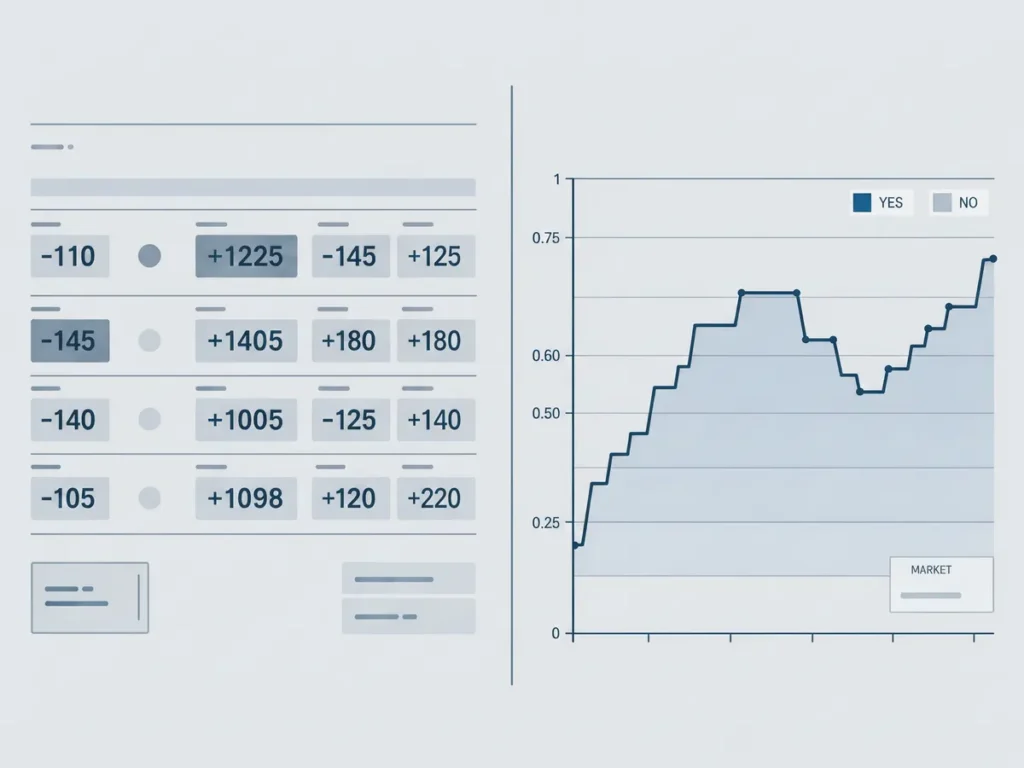
On a sportsbook, your price is fixed at placement; in sports prediction markets, the price keeps moving and you can usually trade out of the position before the event resolves. Say a contract that settles at $1 trades at 40 cents. Buying it risks 40 cents to make 60, the same shape as a +150 moneyline, and the 40-cent price implies a 40% chance. If the market later prices the same outcome at 65 cents, you can sell and bank the difference without waiting for the result.
That flexibility is real. It is not free. The quoted price to buy and the quoted price to sell are not the same number, and the gap between them is a cost you pay the moment you enter. A market quoted 42 to buy and 38 to sell costs four cents on a round trip before anything happens on the field. Where a venue also applies trading or settlement fees, those come out of the same economics. “No house edge” is the wrong mental model. The cost is in the spread and the fee schedule rather than in a vig baked into the odds, and you should read the fee terms on whichever platform you use before assuming it is cheaper.
Market liquidity versus a bookmaker’s posted odds
A sportsbook will always quote you a price, because the book is the counterparty. A prediction market will only fill you if someone is on the other side. On headline markets with heavy participation, that is rarely a problem and the pricing can be tight. On thin or niche markets, the spread widens, size gets hard to place, and the ability to exit early quietly disappears at the exact moment you want it. Liquidity is the feature that makes the product work, and it is unevenly distributed.
One more difference that trips people up: settlement. A prediction market resolves against the defined terms of the contract, including its stated resolution source and timing, which is not always identical to how a sportsbook grades the same event. Parlays are a more mixed picture than the “no combos” framing suggests. Some prediction market platforms, Kalshi among them, do allow same-game parlay-style combo trades, so check what the specific venue supports rather than assuming the product category rules them out.
| Feature | Prediction market contract | Fixed-odds sportsbook bet |
|---|---|---|
| What you hold | A tradable contract on a yes/no outcome | A bet slip at a locked price |
| Price after entry | Keeps moving with the market | Fixed at placement |
| Early exit | Usually possible by selling, if liquidity allows | Only if the book offers a cash-out |
| Operator’s margin | Bid-ask spread plus any platform fees | Vig built into the posted odds |
| Parlays / same-game combos | Available on some platforms, such as Kalshi | Widely offered |
| Counterparty | Other market participants | The sportsbook |
| Settlement | Per the contract’s resolution terms | Per the book’s grading rules |
The oversight sits somewhere other than your state gaming regulator
Prediction markets in the US are generally structured as derivatives rather than as state-licensed sports betting, and the regulatory treatment of event contracts remains unsettled. High Roller’s own disclosure shows the shape of it: ROLR US LLC is a member of the National Futures Association and a registered guaranteed introducing broker operating under a guarantee agreement with OG Markets US, Inc., trading as Crypto.com FCM. Customer accounts are carried by Crypto.com FCM, and ROLR US LLC does not hold customer funds.
Translated, that is a futures commission merchant framework overseen through the federal derivatives system, not a gaming licence issued by a state. The Commodity Futures Trading Commission is the federal agency behind that registration structure. Whether sports-related event contracts belong there at all has been contested between state gaming regulators and federal authorities, and the answer has been shifting. Do not assume availability or legality in your state based on a national launch announcement, and check the current position with a regulator or a reputable legal source rather than a marketing page.
Here is the practical cost of the misreading. If you have been betting with a state-licensed book, you have had a state regulator to complain to, state-mandated responsible gambling tools, and often a state self-exclusion register. A derivatives intermediary answers to a different authority with a different complaints process, and the player-protection features you are used to may not map across one for one. That is worth establishing before you deposit, not after a dispute.
What to work out before you fund an account
Four things, in order. Confirm who actually holds your money and under what registration, because in High Roller’s structure the brand you sign up with is not the entity carrying the account. Read the fee schedule and watch a market’s buy and sell quotes for a few minutes to see what the spread really costs you. Check the resolution terms on any contract you are considering, including the source and the timing. And find out what deposit limits, cool-off options and complaint routes exist on that platform specifically.
Then be honest about the risk profile. A contract that resolves no pays nothing. The early-exit option softens that only while there is a buyer on the other side, and a position you cannot sell is a position you hold to settlement whether you want to or not. The fact that this is a high roller casino operator pivoting into a financial product does not make it a financial product in the sense that matters: it is still real money staked on an uncertain outcome, with a built-in cost of doing business and no expectation of profit.
Set a deposit limit before you start, treat any amount you put in as money you can afford to lose, and if betting has stopped being entertainment, use the cool-off or self-exclusion tools available to you or contact a support service in your state.
Where this leaves bettors
Event prediction markets are going to show up in more places than they do now, pushed by operators who need a growth story and by partnerships that make launching one comparatively cheap. What is genuinely unresolved is whether the current legal footing holds, whether liquidity stays deep enough on anything beyond the biggest markets once launch-week enthusiasm fades, and whether retail pricing stays as tight as the early screenshots suggest.
None of that is settled by a single thinly traded session in a small-cap share price, up or down. The bettors who come out of this well will be the ones who learned what a spread costs and how a contract resolves before they learned which app had the slickest interface.