

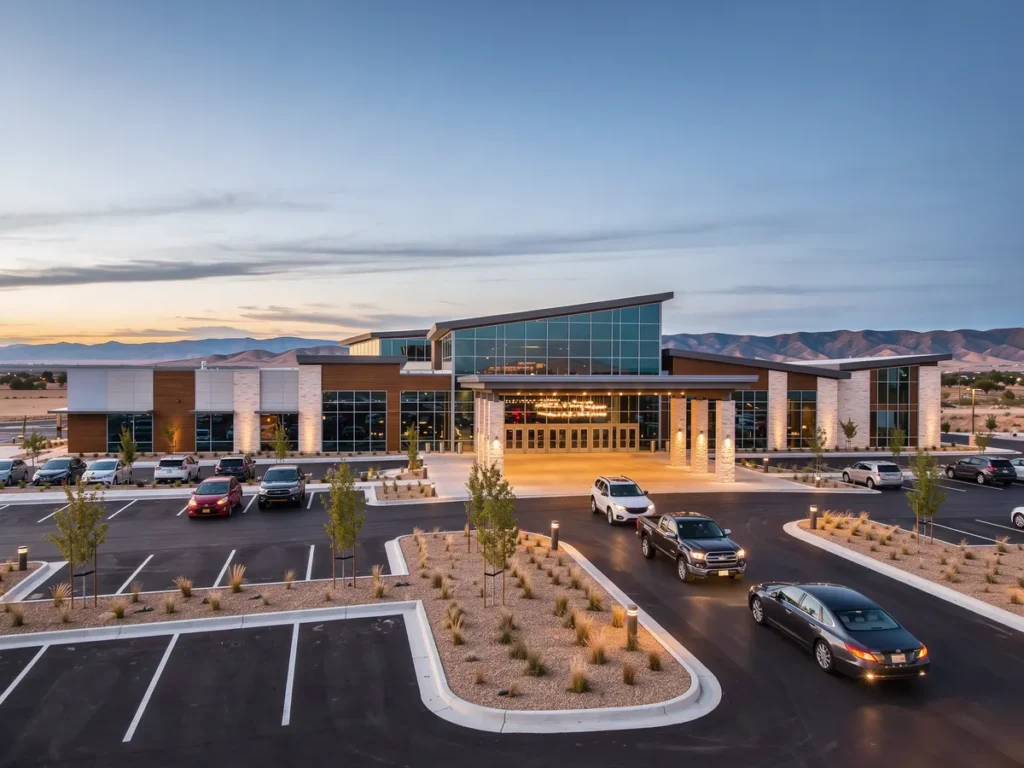
The doors in Madera were supposed to open on Wednesday, October 28, 2026. They opened Tuesday afternoon instead, on October 27, with over 2,400 slot machines already powered up and 40 table games ready to deal. Pulling a launch forward by a day is a small thing operationally and a loud thing commercially: it says the floor was tested, the staff was trained, and nobody wanted to give the queue another night to think about it.
North Fork Mono Casino is now open, and the standard reaction to a new casino opening is that it is good news for players. That reaction is correct. The reasoning behind it is usually wrong, and the gap between the two is worth understanding before you drive out there.
What actually opened in Madera
North Fork Mono Casino is a roughly $725 million all-in resort project in Madera, California, operated by Station Casinos, a consolidated subsidiary of Red Rock Resorts, in partnership with the North Fork Rancheria of Mono Indians. It opened on Tuesday, October 27, 2026, one day ahead of the announced Wednesday, October 28 schedule, with one of the largest gaming selections in the region.
The numbers that matter to anyone deciding whether the drive is worth it:
| Feature | Detail |
|---|---|
| Location | Madera, California (Central Valley, Highway 99 corridor) |
| Project cost | Approximately $725 million all-in |
| Slot machines | Over 2,400 |
| Table games | 40 |
| High-limit room | 138 slots, 10 table games, private bar, dedicated cashier |
| Operator | Station Casinos (Red Rock Resorts) for the North Fork Rancheria of Mono Indians |
| Flagship dining | Manzanita Steakhouse, 250+ wine labels curated by a master sommelier |
| Sports and casual | Clubhouse 99, 56 large-screen TVs, 20+ beers on tap |
That high-limit room deserves a second look. A dedicated cashier and a private bar attached to 138 machines is not a decorative touch, it is a statement about which customer the building was designed around. Resorts of this size are financed on the assumption that a small slice of the floor produces an outsized share of the revenue.
The popular conclusion is right. The usual reason is wrong.
Here is the reasoning I see most often: a new casino arrives, it needs to win customers from established properties, so it loosens the slots and offers better odds. More competition, better math.
That is not how it works. A slot machine’s return to player is set by the game’s configuration and certified before it hits the floor. A 96% RTP game returns about $96 per $100 wagered averaged over millions of spins, which leaves a 4% house edge, and that edge does not soften because a rival property opened 40 miles away. Competition moves marketing budgets, comps, buffet pricing and player club tiers. It rarely moves the paytable, and when it does the change is small enough that you would need a statistician and a year of data to notice it.
So why is the popular conclusion still correct? Because of distance and choice, not price. A player in Madera County who previously drove an hour and a half to reach a comparable floor now has 2,400 machines and 40 tables much closer. Someone who disliked the rules or the atmosphere at their nearest casino now has somewhere else to go. Those are real gains. They are just gains in convenience and variety, not in expected value.
What $725 million buys, and who pays for it
This is the trade-off with no clean answer, and it is the part most coverage skips. A farm-to-table steakhouse with a master sommelier, a sports bar with 56 screens, a private high-limit cashier: all of it is genuinely nicer than what a smaller casino can offer. All of it is also funded by the same house edge you are playing against. The resort does not have a second income stream that subsidises the floor. The floor subsidises the resort.
That cuts both ways and reasonable players land in different places on it. If the dinner and the room and the atmosphere are a real part of why you are going, a $725 million property delivers something a slot barn cannot, and you are buying an evening rather than chasing a return. If you are going purely to play, a big new build gives you no mathematical advantage over a plainer competitor, and the added reasons to stay longer are not neutral. Time on device is the single variable a player fully controls, and resort amenities are designed, quite openly, to extend it.
My own view: the amenities are worth the trip if you treat them as the product. They are a cost if you treat them as a bonus attached to the gambling.
Where this sits in California’s tribal gaming expansion
California has no commercial casinos. Every full casino floor in the state operates under tribal authority, governed by the federal Indian Gaming Regulatory Act and a compact negotiated with the state, which is why Class III games like slots and house-banked tables appear at tribal properties and not at the card rooms that sit alongside them. A project of this size and cost is not a quick build; the capital number itself tells you how long the runway was.
The more interesting structural detail is the operating model. Station Casinos manages the property for the North Fork Rancheria. That arrangement imports Las Vegas locals-market expertise into the Central Valley: loyalty programme design, floor optimisation, food and beverage as a traffic driver. Players will recognise the pattern because it is the same pattern that works on Las Vegas residents. It is professional, it is good at what it does, and it is good at it in both directions.
The number you will not be given
California tribal casinos are not required to publish per-property win or hold figures in the way Nevada operators report to their state regulator. There is no public table you can consult to see whether the slots in Madera hold more or less than the slots at the property you used to visit. Anyone who tells you the new floor is looser or tighter is guessing.
What you can check is in front of you at the game. Posted table rules tell you more than any opening-week press release. Blackjack paying 6:5 on a natural instead of 3:2 adds roughly 1.4% to the house edge, which is larger than the entire edge in a well-played 3:2 game. Roulette with a single zero runs a 2.7% edge against 5.26% with a double zero. On slots, where RTP is rarely posted, understand that volatility changes how the money arrives, not how much of it comes back; a high-volatility game pays rarely and large, and a 96% game is a 96% game either way.
The open question is not whether North Fork Mono Casino succeeds. With 2,400 machines, a hundred-mile catchment and Station Casinos running the floor, that is a reasonable bet. The open question is what a new property 40 minutes closer does to the people who now visit four times a month instead of one. Convenience is the one genuine improvement here, and convenience is also the thing that quietly raises how much you wager in a year. Set a deposit or loss limit before the drive rather than after, use the self-exclusion and cool-off tools every licensed operator is obliged to provide, and treat the steakhouse as the reason you came.