

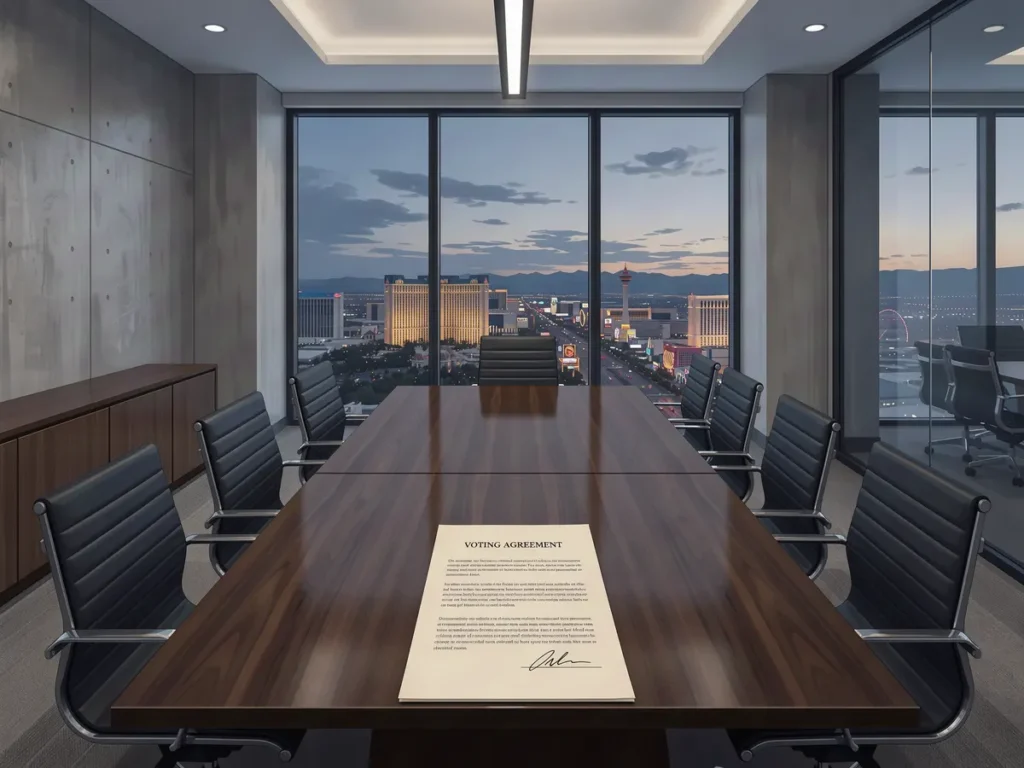
Barry Diller’s People Inc. put roughly $18 billion on the table for MGM Resorts International, then pulled it back. MGM’s stock dropped on the withdrawal. About a month later, the two sides filed new paperwork: an amended MGM Diller voting agreement that, in plain terms, commits People to vote its entire MGM holding the way MGM’s board tells it to in a change of control transaction.
Almost everyone covering this has landed on the same conclusion, which is that the door to a third-party takeover of MGM is now open. That conclusion is correct. The reasoning attached to it, which is that MGM is quietly being shopped, is not supported by anything in the announcement. The door opened for a duller and more durable reason: a shareholder sitting on more than a quarter of the equity, who had publicly said he would not back anyone else’s bid, was a practical veto. The amendment removes the veto. That is the whole event.
What the amended MGM Diller voting agreement actually changes
The April pact between MGM and People, then known for Diller’s long-running vehicle IAC/InterActiveCorp, capped the voting influence of Diller and a set of “covered entities.” After People’s own takeover offer collapsed, Diller made it clear his company would not support a competing third-party bid for MGM. That stance was the obstacle. The new agreement replaces it.
| Provision | Position before the amendment | Under the amended agreement |
|---|---|---|
| Voting on a change of control | Voting influence capped; Diller signalled People would not back a third-party bid | Covered entities vote all MGM shares with the board’s recommendation, subject to certain conditions |
| Further share purchases | No publicly stated ceiling in the amendment announcement | No purchases that would take aggregate ownership above 29.9% of outstanding shares |
| MGM defensive measures | Not addressed in the announcement | MGM will not take defensive measures or actions adverse to the covered entities while they comply |
| Obligation to transact | — | Neither side is obliged to enter any transaction, and MGM says none is contemplated |
Two numbers carry the governance weight here. People holds more than 26% of MGM equity, which makes it the largest MGM shareholder by a wide margin. The new ceiling sits at 29.9%, a stake well above the roughly 10% voting threshold that typically triggers full licensure and control filings in gaming regulation. Diller’s IAC acquired a 12% stake in MGM in August 2020 for a total of about $1 billion. The climb from 12% to 26% came partly from buying more and partly from MGM retiring its own shares.
Three readings of the amendment, weighed
The announcement is short, and each of its clauses supports a different story. Hold them side by side.
MGM is already being shopped
The weakest reading, and the most widely implied. MGM said it is not in takeover talks with another suitor and that no transaction is contemplated. A board preparing a sale process does not usually bother denying one, but it also does not usually hand a 26% holder a published standstill with a precise percentage attached. The amendment reads as preparation for an option, not execution of a plan. Treating it as evidence of an active auction means reading a press release for what it does not say.
A peace treaty that lets the buyback engine run
This is the reading the documents best support. MGM board chairman Paul Salem framed the agreement as giving the board a clear path to maximise value through share repurchases and, if applicable, a change of control transaction, consistent with its fiduciary duties. The shape of the deal matches that framing: People gets protection from poison pills and other defensive measures as long as it stays compliant, MGM gets a cap on accumulation and a pre-committed vote. Neither side has to do anything. Both sides stop spending management time on the question of whether the other is about to move.
Diller is clearing the runway for a second run
The clause that deserves more attention than it has received is MGM’s promise not to take defensive measures adverse to the covered entities. MGM did not spell out what that excludes, though a shareholder rights plan is the obvious candidate. A board that has pre-agreed not to deploy a poison pill against its largest holder has fewer tools if that holder returns with an unwanted offer. Diller has said he remains interested in some future strategic transaction with MGM. Nothing has come of it. But the amendment does not only open a door for third parties; it also removes a lock that would have faced People.
The buyback math nobody has resolved
MGM’s repurchase programme is the mechanism that pushed People’s stake up without People buying anything, and the amended agreement as announced restricts purchases rather than percentages. Shrink the share count enough and a 26% holder drifts toward 29.9% passively. The announcement does not explain how that interaction is handled, and until the full terms are public it is an open question rather than a loophole.
It matters because repurchases are currently MGM’s main lever. The stock is down about 21% year to date, which is the context for a board emphasising buybacks in the same breath as a change of control clause. Cheap shares make repurchases more attractive and a bid more attractive at the same time, which is exactly the position that forces a board to document in advance how a large holder will vote.
Verdict
The popular conclusion survives scrutiny: a third-party acquisition of MGM Resorts is materially more feasible this week than last. The mechanism is not a sale process. It is the conversion of a blocking stake into a pledged one, which is the single most valuable thing any acquirer of a company with a 26% shareholder could be handed.
What remains genuinely unsettled is the phrase “subject to certain conditions” attached to People’s voting commitment. Conditions are where pledged votes go to die, and the announcement does not list them. For anyone tracking casino industry M&A, that language, not the 29.9% cap, is the clause worth reading in full when the complete agreement is filed. Until then, MGM has bought itself optionality and Diller has bought himself protection, and neither has bought a deal.