

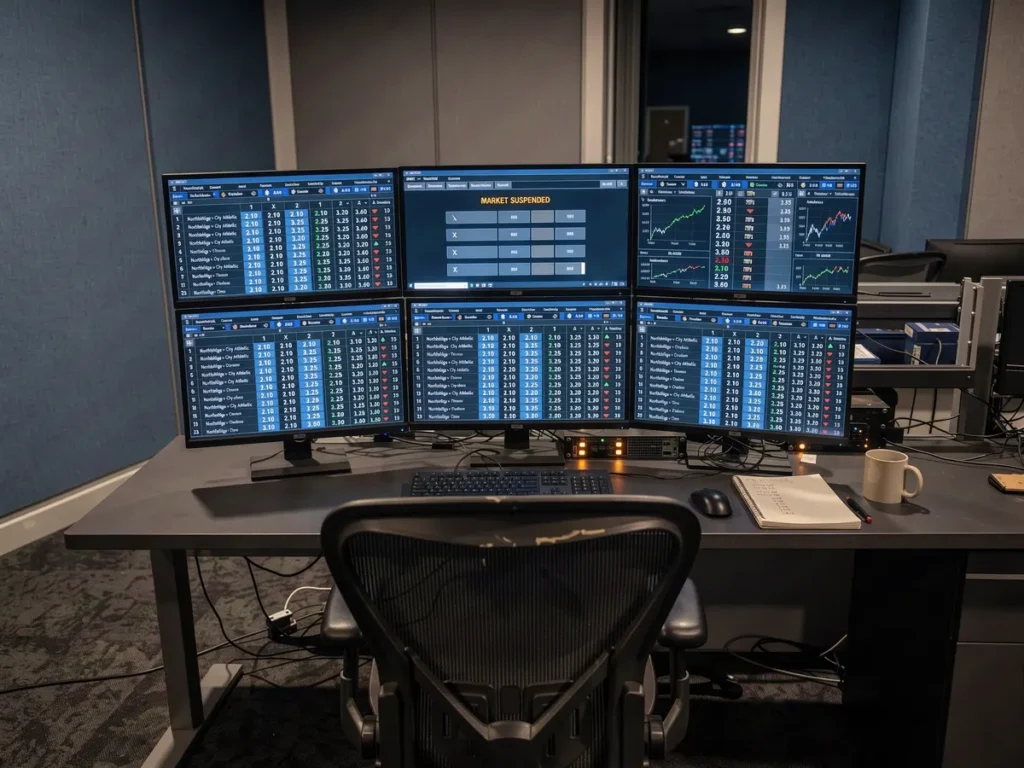
bet365 described its pricing of the odds on Manchester United manager Michael Carrick being sacked as “purely on opinion”, according to SBC News. Not a model. Not a dataset. Opinion. That one phrase tells you more about speculative betting markets than any odds comparison page will.
How bookmakers price manager odds when there is no data to price with
Next-manager odds are set by a trader’s judgment, then moved by media reports, rival prices and incoming money. There is no statistical model behind them because there is no usable dataset: a club appoints a manager once every few years, under conditions that never repeat. Match odds are the opposite, built on thousands of comparable fixtures.
That difference is the whole story, and almost every misconception punters hold about these markets comes from assuming the two work the same way. Three of those misconceptions are worth taking apart properly.
Myth one: there is a pricing model behind the number
There isn’t. The bet365 comment reported by SBC News is unusually blunt about it, and worth reading literally. A compiler looked at the chances of Manchester United parting company with Michael Carrick, formed a view on how likely a dismissal was, and turned that view into a price. The same process produced the prices for every name on the list of possible successors.
Compare that with a Premier League match result. A trader there starts from team strength ratings, expected goals, squad availability, home advantage, rest days and historical results, all fed through a model that produces a probability before any human judgment is applied. The human mostly adjusts at the margins. On a sack market or a next-manager market, the human is the model.
What bet365 and Betfair said, and what they didn’t
The substantive detail in the SBC News coverage is the bet365 line about pricing on opinion. The piece gathered comment from both bet365 and Betfair on how the Manchester United sack and next-manager markets were being handled, but the specific figures and the full wording of each firm’s remarks sit in that article rather than being reproduced here, so treat anything beyond the reported “purely on opinion” framing as my explanation of standard trading practice rather than a quote from either operator.
One structural point does matter for Betfair specifically. Betfair runs a sportsbook with its own compiled prices and an exchange where users back and lay against each other. On the exchange, no trader sets the price at all. It emerges from what people are willing to risk on each side, which is why exchange prices on manager markets often move before bookmaker prices do, and why they are read as a rough sentiment gauge. A sentiment gauge is not a forecast. It is a record of where money went.
Myth two: a next-manager market is just a match market with different names on it
A novelty betting market is one where the outcome depends on human decisions rather than sporting performance, and where no reliable historical dataset exists to price it. Next manager, next permanent dismissal, political leadership contests and reality television winners all fall into this category. Bookmakers often group them under “specials” or “politics and novelty”.
The practical consequences for a punter are not cosmetic:
- Limits are lower. Maximum stakes on a manager market are a fraction of what the same book accepts on a Premier League result.
- Margins are wider, because the compiler’s uncertainty has to be priced in somewhere.
- Rules matter more. Settlement usually hinges on definitions such as “next permanent manager”, which can exclude a caretaker appointment even if that caretaker takes charge of several matches.
- Insider risk is real. A small number of people genuinely know what is happening inside a club, and traders assume some of them bet.
That last point drives more of the behaviour in these markets than most fans realise. A book pricing Liverpool against Arsenal is not worried that someone knows the result. A book pricing a managerial sacking is worried about exactly that.
Myth three: when the odds move, new information must have arrived
Sometimes. Often not. Four things move a speculative price, and only one of them is information about the actual decision.
The first is media reporting. A credible journalist naming a potential successor will shorten that name’s price, whether or not the report turns out to be accurate, because the trader knows what the next hour of betting will look like.
The second is liability. Liability is the amount a bookmaker would have to pay out if a given outcome wins, after accounting for the stakes it has taken on everything else. If one name attracts a disproportionate share of the money, the potential payout on that name grows, and the book shortens the price to discourage further bets and lengthens the others to attract balancing action. The price you see is partly a description of the bookmaker’s exposure, not purely a probability estimate.
The third is one large bet. On a market with a modest stake ceiling, a single wager near the maximum can be a meaningful share of total turnover. On match odds that bet would barely register. On a manager market it can shift a price several points on its own.
The fourth is other bookmakers. Nobody wants to be the only firm offering 6.00 when everyone else has moved to 3.00, because the gap is an open invitation to anyone with better information. Prices converge quickly for defensive reasons.
Why markets get suspended
Suspension is the trader’s emergency brake, and it is pulled when the price on screen is probably already wrong. Typical triggers: a club statement or press conference being announced, a tier-one journalist breaking news, an unusual cluster of bets arriving on one name from accounts with no betting history on football, or a rival book pulling the market first. The market reopens, if it reopens, at a corrected price. Bets already accepted normally stand, which is why news-driven markets vanish from screens within seconds rather than minutes.
The Manchester United market as a live example
The Manchester United sack and next-manager markets are a textbook case because they combine everything above: a club under permanent media scrutiny, a sitting manager in Carrick whose dismissal odds were priced on opinion alone, a long list of plausible successors, and a steady supply of reports with varying reliability.
I am not going to reconstruct a price history for you. The specific odds attached to Carrick or to each possible successor in that reporting are not something I can verify or quote accurately, and a made-up sequence of prices would defeat the purpose of the article. What the SBC News piece does establish is the method: a compiler forming a view on a name, with no model underneath it, in a market where the public’s attention arrived long before any confirmed information did.
What a short price actually tells you
Implied probability is the chance a decimal price reflects, calculated as 1 divided by the odds. A price of 4.00 implies 25%. Add up the implied probabilities of every runner in a market and the total exceeds 100%; the surplus is the overround, the bookmaker’s built-in margin. Here is a hypothetical five-runner market to show the arithmetic, using illustrative prices rather than real ones:
| Runner | Decimal odds | Implied probability |
|---|---|---|
| Candidate A | 2.00 | 50.0% |
| Candidate B | 4.00 | 25.0% |
| Candidate C | 6.00 | 16.7% |
| Candidate D | 11.00 | 9.1% |
| Any other | 13.00 | 7.7% |
| Total | 108.5% |
The 8.5 points above 100% is the margin. On manager markets it is routinely wider than that, because the compiler is guessing and prices the guess accordingly.
So how reliable are these odds as a prediction? There are two defensible readings. One says the favourite in a next-manager market is worth taking seriously, since insiders, journalists and well-informed bettors all push money toward the truth, and the price aggregates what the best-informed people believe. The other says the price mostly reflects which names the media has been repeating, filtered through one book’s liability position. The second reading is the one I would back, with a qualification: the aggregation argument does hold on markets with deep liquidity, and a heavily traded exchange price carries real information. A compiled price on a lightly traded manager market, set on opinion and nudged by a handful of large bets, carries much less. Short odds mean the bookmaker does not want more money on that name. They do not mean the sacking or the appointment is settled.
The cost of confusing those two things is specific: punters treat a shortening price as confirmation, stake more as the odds get worse, and end up backing a reported successor at a price that already contains the whole story and then some. Markets like this are entertainment. Bet only what you can afford to lose, set deposit and loss limits before you start, and if betting stops feeling like entertainment, use the operator’s self-exclusion tools or contact a gambling support service.
What none of this resolves is the question the market exists to answer. A trader’s opinion, priced and published, looks identical on a screen to a probability derived from data. Nothing in the interface distinguishes them. Until a bookmaker labels which of its markets are modelled and which are guesswork, the burden of telling the difference sits with the person placing the bet.