

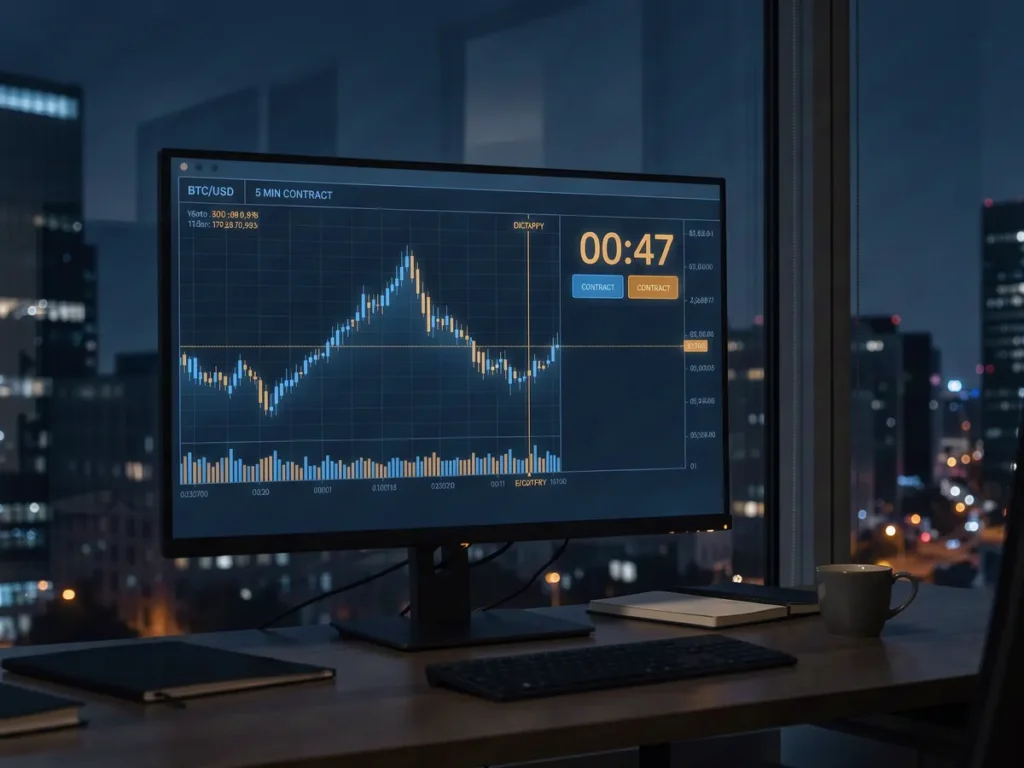
Short-duration Bitcoin is already a tenth of the volume at the biggest US prediction market
Short-duration Bitcoin contracts account for about 10% of contract volume at the top US prediction market on a trailing 30-day average, and 9% at Polymarket’s US platform on the same basis, according to Eilers & Krejcik Gaming analyst Brad Allen. That number is the reason DraftKings crypto event contracts stopped being a footnote and started being a strategy.
Speaking at the NEXTPredict Summit in New York, DraftKings CEO and co-founder Jason Robins said he has softened his stance on digital currency event contracts after seeing early signs of positivity. He did not abandon his original view. Allen’s note from the session has Robins still arguing that sports betting is a better product than prediction markets, while conceding there are lessons to be taken from the category, mainly around how popular the non-sports markets have become.
Allen’s read on which non-sports markets those are is specific: short-duration contracts on the price of Bitcoin. Polymarket’s US arm launched these recently and now runs five-minute Bitcoin markets.
The condition that changes the whole calculation: jurisdiction
The part of Robins’s comments that matters most has nothing to do with volume. He noted that financial event contracts, including timed cryptocurrency derivatives, could remain live in all 50 states even if the Supreme Court rules against sports event contracts.
Read that twice, because it reframes everything else. The legal fight hanging over the prediction market boom is about sports event contracts and whether a federally regulated exchange can offer them in states that never licensed sportsbooks. A contract on the price of Bitcoin at 3:05pm is not a sports contract. It sits on older, far less contested ground as a financial derivative.
So the appeal of crypto event contracts to an operator like DraftKings is not purely that traders like them. It is that they are the part of the product line least exposed to the ruling that could gut the rest. An operator with a 50-state distribution channel and a single-state-by-state sportsbook licence footprint has an obvious reason to care about which products survive an adverse decision.
This is the condition most coverage of the prediction market land grab skips. Volume growth gets the headline; the regulatory classification of the underlying contract decides whether that volume is still there in two years.
What the numbers actually measure, and what they leave open
Three figures are doing most of the work in this story, and each one carries a limit worth stating plainly.
| Figure | What it measures | What it does not tell you |
|---|---|---|
| 10% of contract volume (top US prediction market) | Share of traded contracts from short-duration Bitcoin markets, trailing 30-day average | Share of revenue, notional value, or unique traders |
| 9% of US contract volume (Polymarket) | Same metric at a platform that only recently launched these markets | Whether the share holds once the novelty of five-minute markets fades |
| 44x growth in the first seven months of 2026 | Reported surge in prediction market volume on timed crypto derivatives | The starting base, which has not been published |
A 44x increase off a near-zero base is a different event from a 44x increase off a meaningful one, and nobody has shown the denominator. Contract volume is also the friendliest available metric for short-duration products by design: a five-minute market produces twelve times as many contracts per hour as an hourly one, with no implication that more money is moving. Treat the 10% as evidence of trader appetite, not as a proxy for the economics.
What is genuinely notable is the timing. That growth happened while prices on major cryptocurrencies, Bitcoin included, languished through much of the year. Volume rising in a flat or falling market suggests the draw is the short clock and the binary payout rather than directional conviction about crypto.
DraftKings does not own this volume yet
Crypto contracts offered through DraftKings Predictions are not routed through DKeX, the company’s own exchange. They go through Crypto.com, which is a sensible partner for the asset class and also means the economics of every crypto trade are shared rather than captured.
Allen raises the possibility that DraftKings is looking at in-housing that volume. That is an analyst’s inference, not a company announcement, and it should be read as exactly that. But the logic is not hard to follow: DraftKings built DKeX precisely so it would not have to rent exchange infrastructure, and a product line pulling a tenth of category volume elsewhere is the kind of thing an operator eventually wants on its own rails.
What has not been disclosed anywhere is how much crypto contract volume DraftKings Predictions is currently doing, or what the revenue split with Crypto.com looks like. Without those two numbers, any estimate of what in-housing would be worth is guesswork, and I am not going to supply a plausible figure to fill the hole.
A five-minute Bitcoin market is a wager wearing a derivative’s paperwork
Critics of timed crypto event contracts argue they are gambling in a different package, and on the substance of the thing they are right. A binary contract on whether Bitcoin is above a given price in five minutes is a short-odds proposition with a defined stake, a defined payout and a fixed settlement time. The fact that it clears through a derivatives venue rather than a sportsbook changes the regulator, the tax treatment and the marketing language. It does not change what the participant is doing.
That distinction matters for anyone trading these products. Exchange-traded event contracts generally do not come wrapped in the deposit limits, loss caps, cool-off tools and self-exclusion options that licensed sportsbooks are required to offer. Spread across a five-minute cycle, the gap between a market with those guardrails and one without them widens fast. If you are using these contracts, set your own limits, because the venue is unlikely to set them for you.
The industry’s own framing also deserves a sceptical eye. Robins arguing that sports betting remains the superior product while simultaneously leaning into crypto contracts is not a contradiction; it is an operator telling you which product he prefers and which one he can offer everywhere.
What is still open
Three things decide whether this becomes a real business line for DraftKings or a hedge that never gets used. The Supreme Court has to rule on sports event contracts, and the scope of that ruling will determine how much of the prediction market product survives outside licensed states. DraftKings has to decide whether to keep routing crypto trades through Crypto.com or move them onto DKeX. And crypto volume has to prove it can hold up across a full price cycle rather than just a flat one.
There is a tempting fourth variable floating around the discussion: the argument that if Bitcoin is following its historical four-year cycle, a bottom and a new bull market would push contract volume higher still. That is a pattern-based expectation, not a forecast with a mechanism behind it, and past cycles do not oblige the next one. Build a view of DraftKings crypto event contracts on the jurisdiction argument and the volume data. The cycle call is the part to leave in the “unknown” column.