

Bugsy Siegel is the gangster who built Las Vegas. That is the line you have heard, and it is roughly a third true. The new Bugsy Siegel exhibit at the Mob Museum is a good excuse to work out which third, because the objects on display say far more about what the mob actually brought to Nevada than any of the legends do. They brought cash, cover and a counting room. The architecture was someone else’s idea.
What the Mob Museum is putting on display
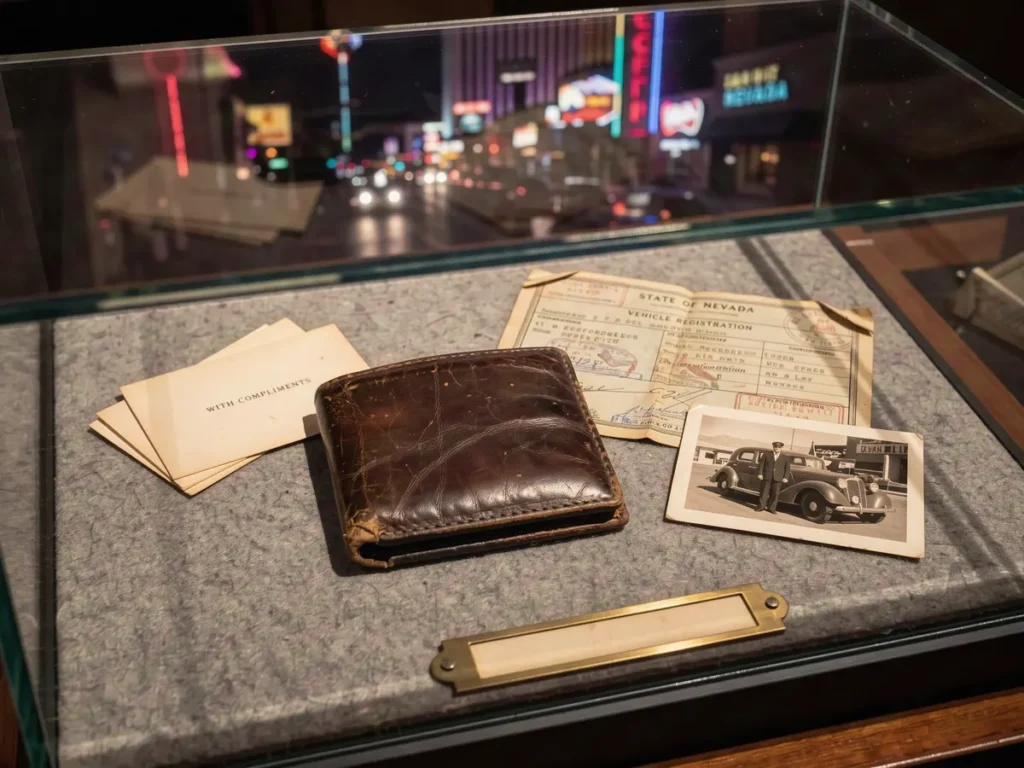
The museum will begin showing personal effects pulled from Siegel’s pockets after his murder, opening Friday, Nov. 13, 2026. Beverly Hills police collected 22 items as crime scene evidence on June 20, 1947, and held them for nearly eight decades. According to Casino.org’s reporting on the acquisition, the museum has permanently acquired some of them for an undisclosed sum.
The contents are mundane in a way that makes them useful. A Social Security card. A 1947 American Red Cross membership card and an Automobile Club of Southern California card. Calling cards printed with “Ben Siegel” and “Mr. Benjamin Siegel.” A faded Yellow Cab receipt for a 50-cent fare in Los Angeles from January 1947, back when he was shuttling constantly between Southern California and the desert. A Nevada certificate of vehicle ownership issued less than two months before his death, naming him as owner of a 1946 Chrysler Windsor convertible coupe and listing the Flamingo Hotel as his home address.
Two items do real historical work. One is a business card for Meyer Lansky, which identifies him as a distributor of Wurlitzer jukeboxes in New York. The other is a card for the Dixie Shops, a national chain of women’s apparel stores, printed with Siegel’s name. Geoff Schumacher of the Mob Museum told Casino.org he suspects that one was phony, there to give Siegel the appearance of a legitimate occupation. A fake job and a jukebox distributor: that is the entire business model of the era in two pieces of cardstock.
There is also a photograph of his girlfriend Virginia Hill, inscribed on the back “Sweetheart Benny I love you Pup,” photos of his daughters Barbara and Millicent, and a handwritten note reminding him of Hill’s address at 810 North Linden Drive. That is the house where he was shot while reading the next day’s Los Angeles Times on the living room couch at 10:45 p.m. Hill was in Paris. The items reached the museum through Siegel’s granddaughter, Wendy Rosen, who sued the Beverly Hills Police Department to recover them and whose attorney approached the museum after a judge ruled the material should go back to the family.
Siegel did not dream up the Flamingo
Benjamin Siegel was a Brooklyn-raised criminal who rose through Prohibition-era bootlegging and the New York rackets alongside Meyer Lansky, then relocated to Los Angeles in the late 1930s to run West Coast interests for his East Coast partners. He hated the nickname Bugsy. What he did not have was an original idea about Las Vegas.
Nevada had legalized wide-open gambling in 1931. By the time Siegel got involved, the highway south of town already had resorts on it: El Rancho Vegas opened in 1941, the Hotel Last Frontier in 1942. The Flamingo itself was conceived by Billy Wilkerson, founder of The Hollywood Reporter, who ran out of money mid-construction and took on investors he could not later shake off. Siegel’s group moved in, Wilkerson moved out, and history handed Siegel the credit.
Financing the Flamingo with mob money
What Siegel genuinely supplied was capital nobody else would provide. No bank in 1946 was lending millions against a desert casino, so the money came from men who had cash they needed to move and no interest in a prospectus. The budget ran wildly over, from a figure commonly reported around $1 million to something in the range of $6 million, and those overruns came out of the pockets of partners who did not take losses philosophically.
The Flamingo opened on December 26, 1946, flopped badly enough to close within weeks, and reopened in March 1947. That sequence matters more than the glamour. The lesson the mob took from it was not that Siegel was a visionary. It was that a casino is a machine for turning anonymous cash into legitimate-looking income, and that machine works whether or not the man running it has taste.
Why Siegel was killed
Nobody knows. The murder was never solved, and no one was ever charged. The standard account, that Siegel was executed for skimming construction funds or for the Flamingo’s losses, is a reasonable inference told with far more certainty than the evidence supports. His partners had motive; so did several other people. Repeated often enough, a plausible theory starts getting quoted as a finding. Treat it as the open question it is.
How the mafia actually ran early Las Vegas casinos
Organized crime profited from early Las Vegas mainly through skimming: taking cash out of the count room before it was ever recorded, so it never appeared as revenue and was never taxed. A casino is the one business where enormous sums arrive in untraceable paper from customers who expect no receipt. Lift a percentage off the top, and the books still balance. The state collects tax on a smaller number. Couriers carry the difference back to Chicago, Kansas City, Cleveland or Miami.
The second mechanism was hidden ownership. Licenses went to front men with clean records, while the real financiers held undisclosed points behind them. Through the 1960s and 1970s, Teamsters Central States Pension Fund loans financed properties whose nominal owners answered to people with no license at all. The federal “Strawman” prosecutions of the early 1980s, built around the skim at the Argent-run Stardust and other houses, put Midwest crime bosses in prison and documented how the arrangement worked.
Why Nevada? Gambling was legal there and almost nowhere else in the country, licensing was administered loosely by the Nevada Tax Commission after the state took over the job in 1945, the business ran on cash, and the men who knew how to run illegal casinos in Florida and Kentucky already had the staff, the equipment and the customers.
The paperwork that did what bullets could not
What pushed the mob out of Las Vegas was licensing law, not law enforcement. Siegel’s murder changed nothing about who owned the Flamingo. A regulator with the power to deny a license, investigate your financing and bar you from the premises changed everything.
| Year | Change | What it did |
|---|---|---|
| 1931 | Nevada legalizes gambling | Created the only large legal casino market in the US |
| 1955 | Gaming Control Board established | Gave the state a dedicated investigative and enforcement arm |
| 1959 | Gaming Control Act | Created the Nevada Gaming Commission; split policy and licensing from investigation |
| 1960 | List of Excluded Persons | Barred named individuals from entering any licensed casino |
| 1967, broadened 1969 | Corporate Gaming Act | Let publicly traded companies hold licenses without licensing every shareholder |
Licensing with teeth
The 1955 Gaming Control Board put professional investigators on applicants’ backgrounds and money. The 1959 Gaming Control Act built the two-tier structure Nevada still uses: the Nevada Gaming Control Board investigates and recommends, the Gaming Commission grants, conditions or revokes. Crucially for the mob, a license became a privilege rather than a right, and a privilege can be withheld because of who is standing behind you.
The black book
The List of Excluded Persons, universally called the black book, launched in 1960 with an initial roster of eleven men. Anyone on it commits a crime by setting foot in a licensed casino, and any operator who lets them stay risks its license. It was blunt, and it worked on exactly the problem hidden ownership created: it stopped mattering whose name was on the paperwork if the man who really mattered could not walk through the door.
Wall Street takes the count room
Corporate ownership arrived because the law finally allowed it. Before 1967, every shareholder in a licensed company had to be individually licensed, which made public ownership impossible and left the business to private money of uncertain origin. The Corporate Gaming Act of 1967, broadened in 1969, scrapped that requirement for publicly traded companies.
Howard Hughes supplied the demonstration. He checked into the Desert Inn in November 1966, declined to leave, and bought the place in 1967, then added the Sands, the Frontier, the Castaways, the Silver Slipper and the Landmark. Nevada regulators were delighted to swap unverifiable partners for an eccentric billionaire with audited money. Once Hilton and other public companies could hold licenses, capital markets replaced pension fund loans, and a company answerable to the SEC and its own shareholders had no appetite for a skim.
Why a dead man’s pockets still pull a crowd
The Mob Museum sits in the former federal courthouse and post office downtown, in the building where a Kefauver Committee hearing on organized crime was held in 1950, which gives its collection an unusually literal address. Siegel’s effects fit that frame because they are not sinister. Schumacher said there is nothing mysterious about any of them, and he is right. They are a car registration, a cab fare, a fake retail business card and a photo of two daughters.
That is the honest version of the story. The mob did build a large part of early Las Vegas, but through financing and cash handling rather than vision, and the man most associated with it was neither the architect of the Flamingo nor, as far as any court ever determined, murdered for a reason anyone can prove. Go and look at the cards yourself from November 2026 at the Mob Museum, and decide how much of the legend the evidence will actually carry.