

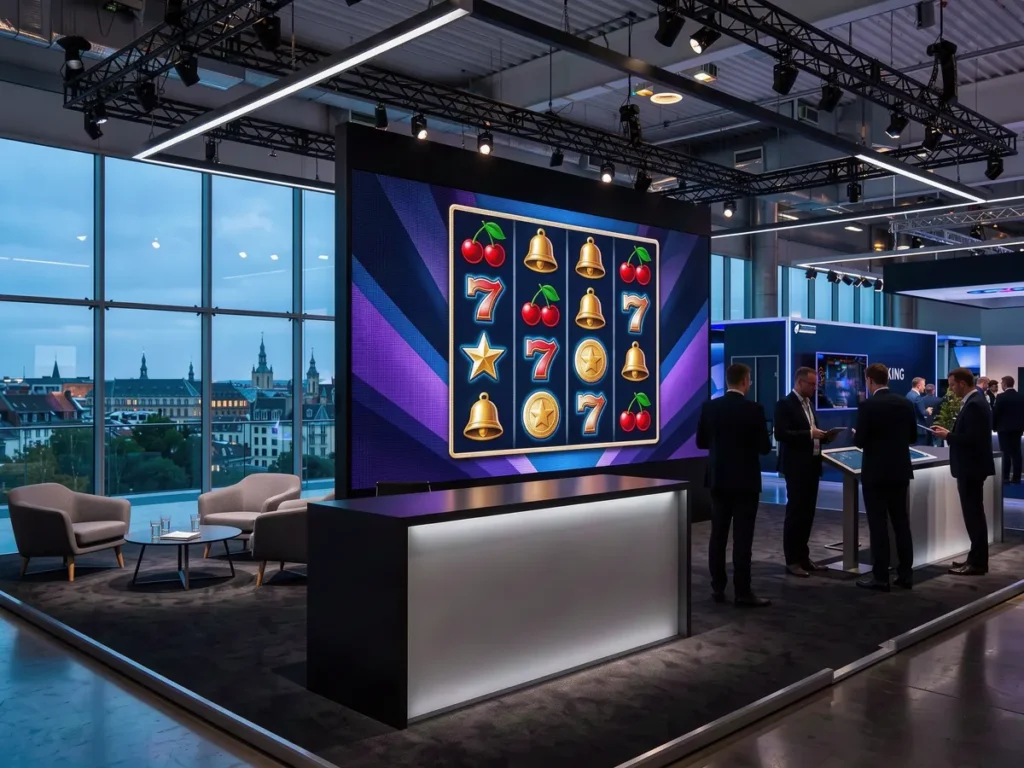
The games in your casino lobby were not voted in by players. They arrived because a business development manager and an operator’s content team agreed terms, usually in a meeting room at a trade show. That is the honest mechanism behind slot game variety, and it is why an interview published on 28 October 2026 with Alena Zaytseva, Senior Business Account Manager at the 1spin4win slot provider, is worth reading even if you have never heard the studio’s name.
Speaking to Focus Gaming News around SiGMA World in Rome, Zaytseva said strengthening the company’s presence in Europe is one of its main goals for the event: expanding its European operator network and introducing more potential partners to a portfolio of more than 200 classic slots. Alongside that, the studio reported first-half 2026 year-on-year growth of 47 per cent in gross gaming revenue and 46.66 per cent in bets.
1spin4win as a slot provider: classic reels, 200-plus titles
1spin4win is a slot studio built almost entirely around classic slots, with a catalogue of more than 200 titles. Classic slots means the older shape of the genre: few reels, a modest number of paylines, fruit, bar and seven symbols, and features kept deliberately thin compared with the 243-ways and Megaways releases that dominate most lobbies.
That specialisation matters more than the headcount of games. A studio with 200 classic slots is not offering 200 different experiences. It is offering one mechanic, carefully varied, in 200 skins. Some players love exactly that, and the pattern is familiar to anyone who has watched a crowded casino floor gravitate to the simplest machines. Others will find the whole catalogue interchangeable after half an hour.
What the H1 2026 growth figures do and do not say
The growth numbers describe distribution, not game quality. GGR up 47 per cent and bets up 46.66 per cent year on year means wagering volume and the studio’s revenue grew at almost exactly the same rate, which tells you the margin per bet stayed essentially flat and the extra revenue came from more players and more operators, not from games holding back more money. A third growth figure of 59.06 per cent also appears in the studio’s first-half summary; the published interview does not make clear which metric it belongs to, so treat it as context rather than a fact you can use.
| Reported metric | H1 2026 year-on-year growth | What it measures | What it does not tell you |
|---|---|---|---|
| GGR | 47% | Total wagers minus payouts, before costs | Any individual game’s RTP or your chance of winning |
| Bets | 46.66% | Volume of wagers placed on the studio’s games | How many distinct players, or how long they played |
Read the first row carefully, because GGR is the industry’s polite name for the money players did not get back. A provider’s GGR growing is a sign that its games are being played in more places, nothing more. It is not a quality rating, and it is certainly not an indication that the games pay better than anyone else’s. Slot RTP generally sits somewhere around 94 to 97 per cent, the house edge is the remainder, and no amount of supplier growth changes that arithmetic.
Why conference season quietly rearranges your lobby
Events like the SiGMA conference circuit are where content deals get signed, which is why October and the weeks after it tend to be when new studios start appearing in familiar casino lobbies. The sequence is unglamorous and goes roughly like this.
- A studio books a stand and sets a target, as 1spin4win has done with its European operator network.
- Meetings with operators and aggregators produce integration agreements.
- Games are certified for each licensed market, because a title cleared in one jurisdiction is not automatically allowed in another.
- The operator decides which of the available titles to actually surface, and where in the lobby.
Step four is where most of the promised variety evaporates. A studio can sign a deal covering all 200 of its slots and still see a dozen appear on the front page, because lobby space is commercial real estate and operators merchandise what already performs. European iGaming market expansion by a supplier is a prerequisite for you seeing its games, not a guarantee.
More titles is not the same as more slot game variety
Variety that benefits a player is variety of mechanics and volatility, not variety of artwork. Two slots with the same reel layout, the same hit frequency and the same volatility band are one game with two backgrounds, however different the symbols look. When a new provider arrives in a lobby, the question worth asking is whether it brings a mechanic the lobby was missing.
Classic slot specialists usually do bring something distinct, and it is not nostalgia. Simpler games tend to be legible: fewer paylines, a paytable you can read in one screen, no cascading multiplier chain you have to reverse-engineer to understand what just happened. For a beginner trying to learn how a slot actually resolves a spin, that legibility is a genuine advantage over a feature-stacked release. What it does not do is improve your odds. Simplicity and house edge are independent of each other.
The useful move for players watching supplier news
Supplier expansion stories are worth tracking as a signal of what will appear in your lobby next quarter, and worth ignoring as a signal of anything else. If 1spin4win’s push into Europe succeeds, the practical consequence for a player in a regulated European market is a handful of extra three-reel titles in the slots section, possibly under a “classic” filter that most people never click.
What stays open is the part the interview could not answer: how many of the 200-plus titles clear certification in each European jurisdiction, and whether the European operators signed in Rome put them anywhere a player will find them. Those answers arrive in lobbies, not in press coverage. When they do, open the game’s info screen, check the stated RTP and the paytable before the first spin, and set a deposit or session limit that assumes the house edge will do what it always does over time.